


επανάσταση
Σημαίνει επίσης και περιστροφή (π.χ. γύρω από έναν άξονα)
Παραδείγματα:
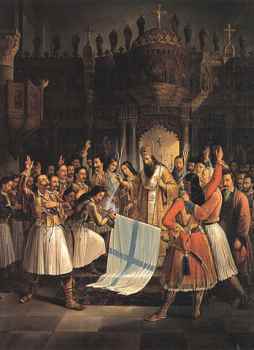
- In Greek, the 25th of March, the Greek Independence Day, is called “The Revolution against the Ottoman Empire”. Στα Ελληνικά, η 25η Μαρτίου, η Ημέρα Ανεξαρτησίας της Ελλάδας, λέγεται “Η επανάσταση εναντίον της Οθωμανικής Αυτοκρατορίας”.
- The French revolution caused a shift of power from the church to the state. Η Γαλλική επανάσταση προκάλεσε μετακίνηση της εξουσίας απ’ την εκκλησία στην πολιτεία.
- I think they want to make a revolution. Νομίζω θέλουν να κάνουν επανάσταση.
- This engine can reach 12.000 RPM (Revolutions per Minute). Αυτός ο κινητήρας μπορεί να φτάσει τις 12.000 στροφές το λεπτό.
Επαναστάσεις:
If we look across history, misery — economic hardship, oppression, hunger, and despair — has been a recurring spark for revolutions far more often than abstract ideology alone. Ideals like liberty or equality often give form and language to revolts, but the emotional and material energy that pushes people into open rebellion usually comes from suffering they can no longer tolerate.
For example:
- The French Revolution was preceded by famine, taxation injustice, and economic collapse.
- The Russian Revolution followed years of war, poverty, and hunger.
- Even modern uprisings (e.g., in the Arab Spring) often began with economic frustration and lack of dignity rather than pure ideology.
So, while ideas do guide revolutions, it is misery that ignites them.
Of course there are exceptions.
One such exception was the the American War of Independence (1775–1783).
Unlike the French or Russian revolutions, the American colonists were not starving, impoverished, or oppressed in daily life.
- The colonies were relatively prosperous, literate, and had a growing middle class.
- There was no widespread famine or economic collapse.
- Most colonists enjoyed a standard of living higher than many Europeans at the time.
So, material misery was not the main driver in that case.
That revolution was instead fueled by a sense of political injustice and loss of autonomy — not existential suffering.
Key issues included:
- Taxation without representation: the idea that London imposed taxes without giving the colonies a voice in Parliament.
- Restrictions on trade and westward expansion.
- A growing sense of American identity and desire for self-governance.
So the American War of Independence was a revolution of principle, rooted in Enlightenment ideas about liberty, consent, and natural rights — not one of desperation.